
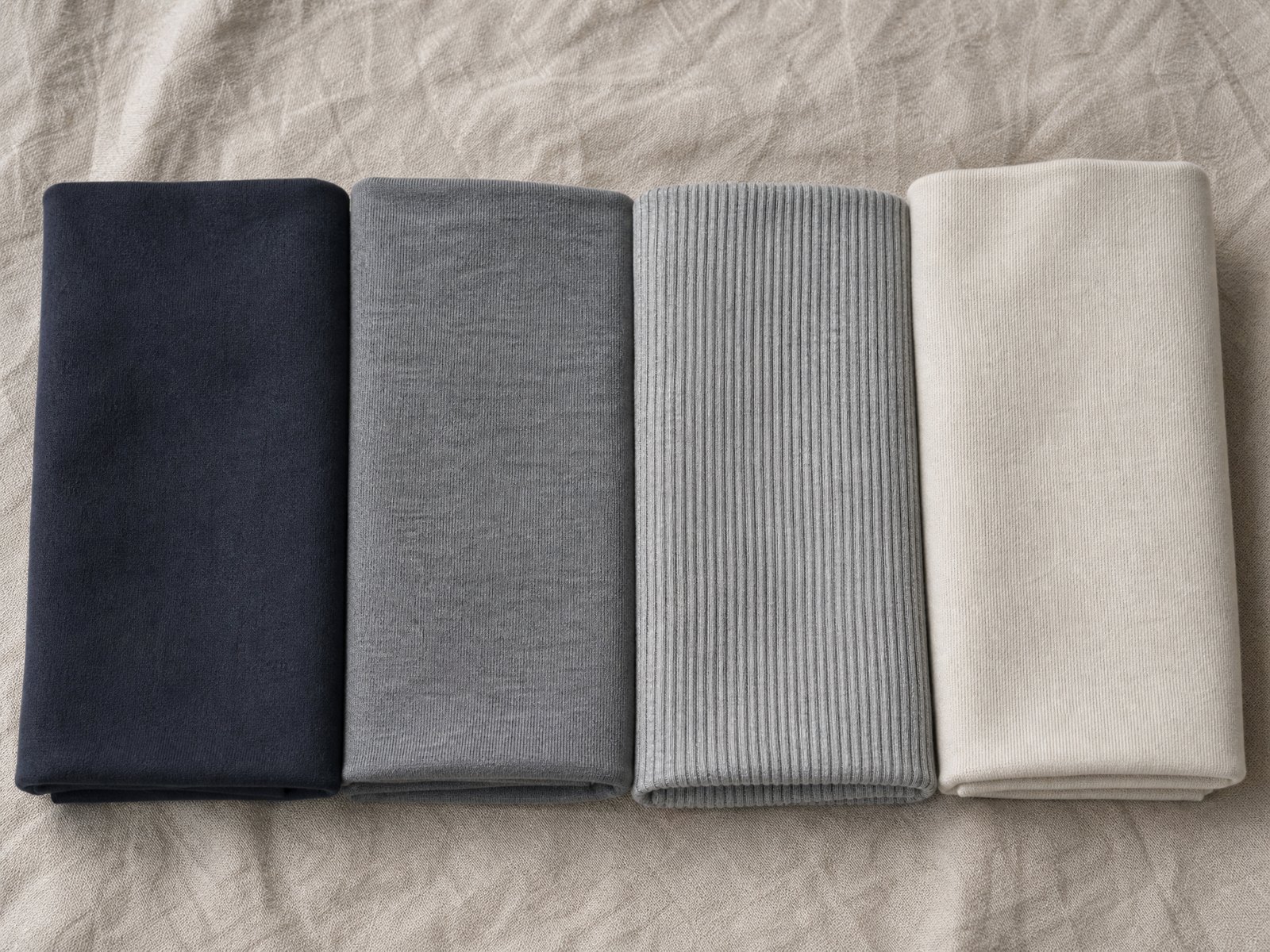
What we buy, and what it costs us
Second-skin layers live or die on the knit, so we work with five fabric families and accept what each one costs rather than pretending one material does everything. Every product page lists the exact composition of the piece in front of you, because a tank body, a smoothing front panel and a hem band are often three different fabrics.
Recovery double-knit: recycled polyamide with elastane
This is the backbone of the range. Sculpt tanks, cycle shorts, high-waist leggings and base layer bodysuits are knitted from recycled polyamide with 16 to 24 per cent elastane, at 240 to 300gsm. Double-knit means two interlocking faces rather than one, which is why it stays opaque when stretched, carries a smoothing panel with no visible ridge, and does not curl at a cut edge, so we can bond a hem flat instead of turning and stitching it. Polyamide takes dye deeply and evenly, which is how we get a saturated navy and a claret that does not go dusty, and blended with elastane it recovers again and again.
The honest costs: it holds warmth and moisture more than cotton, so on a hot day it feels less breathable; it takes on odour faster and wants washing after every wear; and like every synthetic it sheds microfibres in the wash, which a filter bag and a low spin reduce.
Cotton-modal interlock
Long-sleeve base layers and the softest tanks use a combed cotton and modal interlock with 5 to 8 per cent elastane, at 200 to 240gsm. Interlock is smooth on both faces and dimensionally stable, so it does not twist round the body after washing. Cotton is absorbent and breathable; modal adds a cool, fluid hand that cotton cannot reach on its own, holds colour through repeated washing, and gets softer rather than rougher with age. Where fabric sits against the most sensitive skin for eight hours, this is what we reach for.
The trade-off is water. Cotton holds a lot of it, dries slowly and stretches while wet, which is exactly why these pieces have to dry flat. Modal is weaker wet than cotton, so we blend it rather than use it alone and keep it out of high-abrasion places such as the inner thigh.
2×2 rib
Ribbed body tanks and cap-sleeve tops are knitted as a 2×2 rib, mostly combed cotton with about 6 per cent elastane, at 220 to 260gsm. Rib is alternating raised and sunken columns, so it compresses flat and springs back across its width. That is why a ribbed tank measures far smaller on the table than the body it fits, and why it holds without any fastening. Rib is forgiving about size but it is not a smoothing fabric: the columns follow what is underneath rather than levelling it, and it grows lengthwise if you hang it.
Seamless circular knit
Our under-layer skirts and some tanks are knitted as a tube on a circular machine, so there is no side seam at all and the shaping is knitted in as changes in stitch density rather than sewn. Nothing rubs, nothing prints through a fine fabric worn over the top, and the edges are knitted closed instead of hemmed. The limits are worth knowing: shaping is softer than a cut-and-sewn piece can achieve, sizing is broader because the knit has to cover a wider range, and a pulled thread runs along a course rather than staying local. It is the least repairable thing we make.
Power mesh
Where a panel has to hold, we use a flat polyamide-elastane warp knit rather than doubling up the body fabric. It gives firm hold at very little thickness, leaves no visible edge under clothing, and breathes better than two layers of double-knit. It is also the least durable fabric here, since it snags easily and heat kills it first, so it lives inside a front panel and is never an outer face.
Elastane, plainly
Elastane sits between 5 and 24 per cent depending on the job. It is what makes a waistband stay put and a fitted layer come back rather than bag out at the knee or the elbow. It is also the shortest-lived fibre in the piece: heat, chlorine, oil and antiperspirant all degrade it. A high-elastane compression piece has a shorter working life than a cotton-rich one, and we would rather write that down than sell you a promise we cannot keep.
Colour, and what we avoid
Navy, claret and plum are dyed at piece stage, which bonds dye to the fibre and gives depth that survives washing. Very dark shades can rub off slightly onto a pale bag strap in the first two wears, so wash before first wear if that matters. Chalk white is undyed and warms slightly with age. Bare stone and slate rose are the hardest shades to match between lots, so order those together.
What we will not use: silicone strip along hems, which drags on skin and peels away within a dozen washes; moulding, foam, boning or metal anywhere; and fusible interlining inside a stretch panel, which cracks once the knit has moved a few hundred times.
For the full composition of a style, including thread and label content, email support@fitslike.shop and we will read it off the roll. Fabric notes for the range sit at our materials page.
FITS LIKE LIMITED
Company number 17266485, registered in England and Wales.
Registered office: 14 Greenhill Road, Farnham, GU9 8JP, England
Email: support@fitslike.shop
FITS LIKE LIMITED is not currently registered for VAT. No VAT is charged on the prices shown on this website.